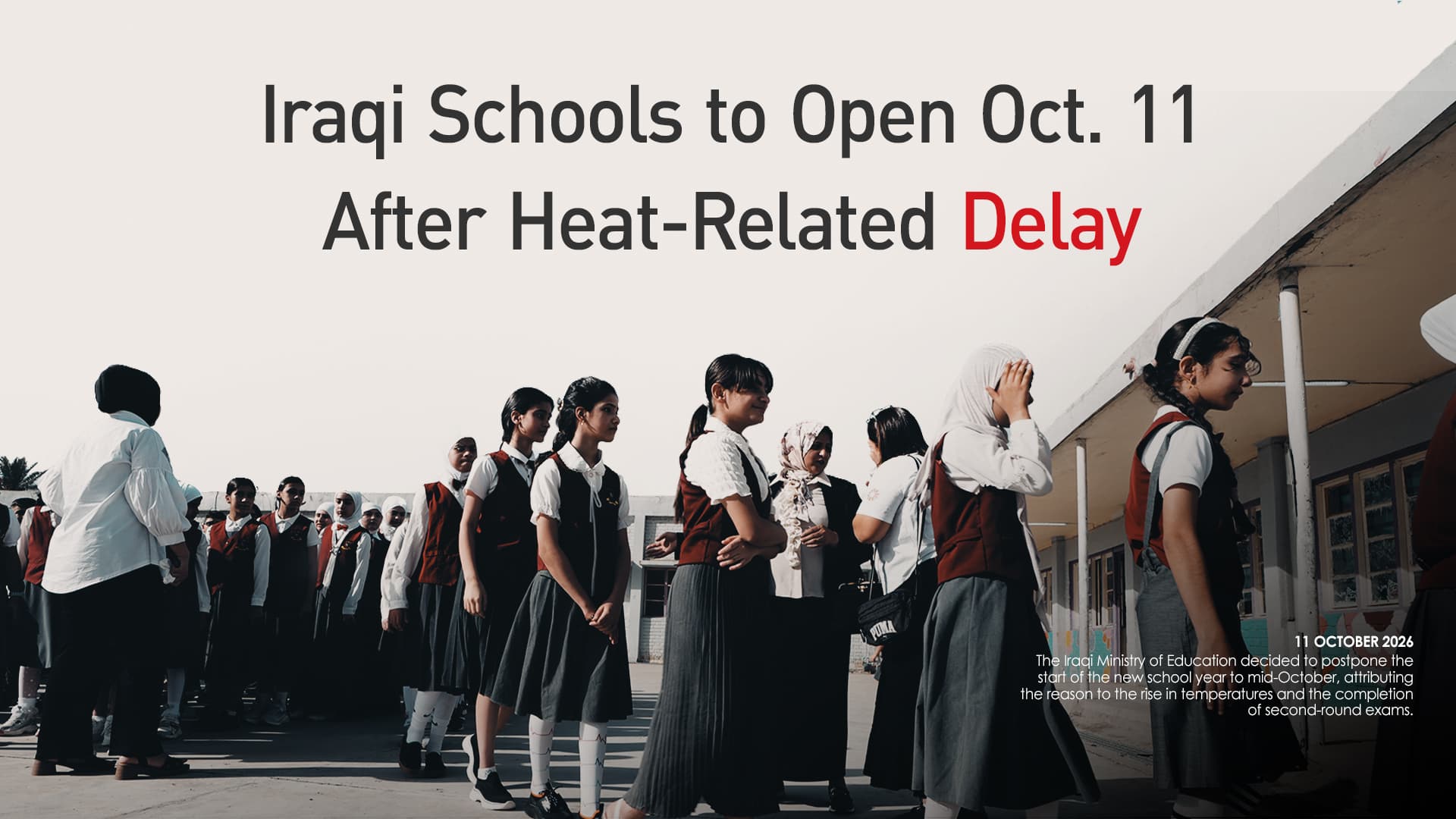
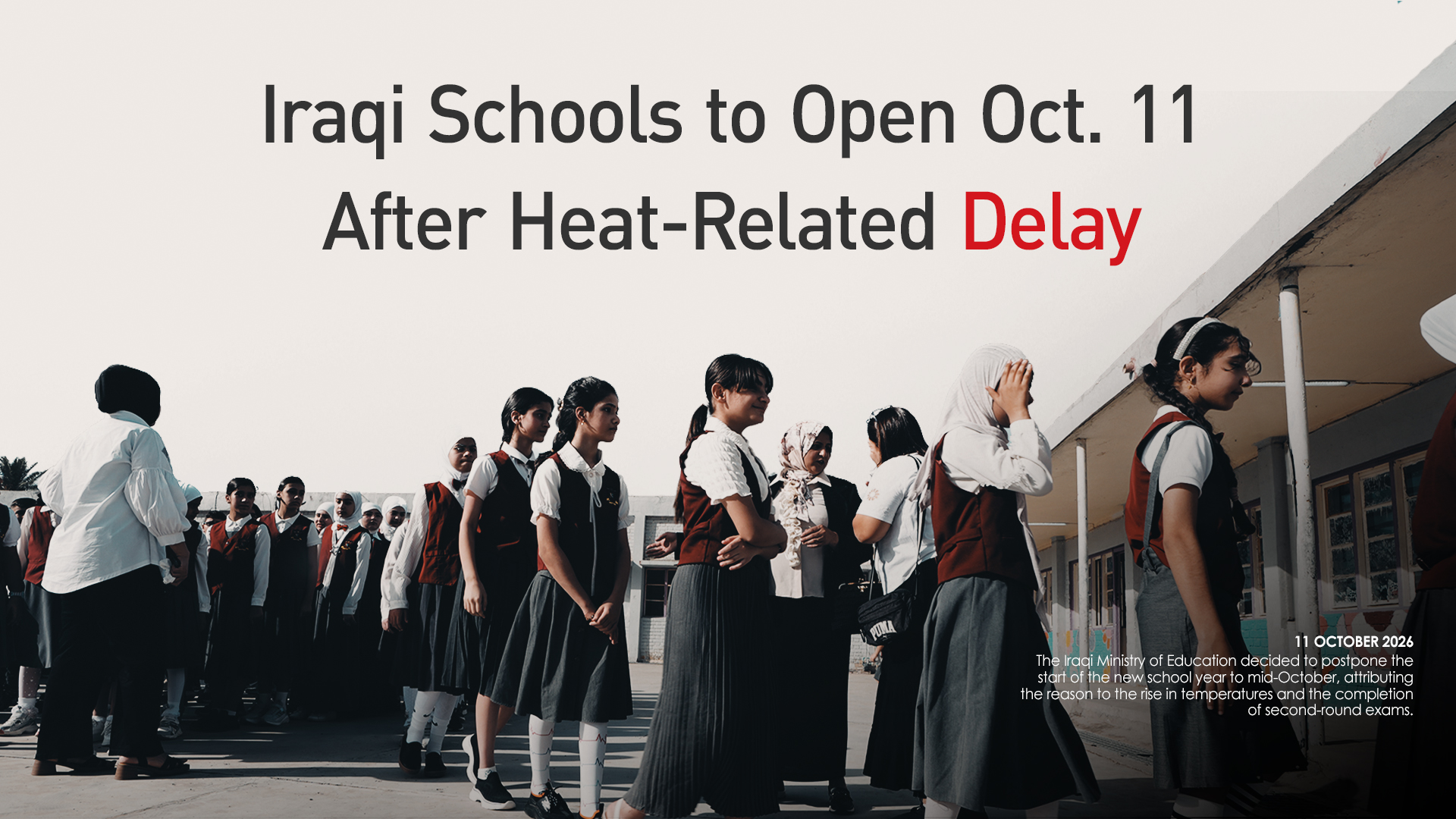
ERBIL () - Iraq has postponed the start of the 2026-2027 school year until Oct. 11, citing persistent high temperatures, unfinished second-round examinations and the need for additional preparations, a decision that also exposes deeper weaknesses in a school system struggling with overcrowded buildings, unreliable electricity and inadequate cooling.
An official Ministry of Education directive issued Tuesday, Sept. 15, moved the first day of classes from the previously scheduled Sept. 20 date to Sunday, Oct. 11.
The directive, signed by Ali Saud Abdulmajid, Director General of Public, Private and Foreign Education, was issued with the approval of the education minister and circulated to education directorates across Iraq for implementation.
The ministry said the delay would allow sufficient time to complete second-round examination procedures for non-graduating grades and finalize preparations for the new academic year.
It also explicitly cited Iraq's continuing high temperatures.
The postponement comes at a time when many schools lack the infrastructure needed to operate safely during prolonged periods of intense heat.
In central and southern Iraq, temperatures can remain above 40 degrees Celsius well into the autumn. Many classrooms lack reliable electricity, air conditioning or sufficient ventilation, making extended periods of study particularly difficult for students and teachers.
Heat Meets an Already Strained School System
The immediate decision concerns this year's calendar, but the pressure behind it is structural.
Iraq has a severe shortage of suitable school buildings, forcing many facilities to accommodate two or even three separate shifts of students each day.
That system reduces classroom time and can require children to attend during hotter parts of the day, while leaving little time between shifts for maintenance or cooling.
According to the Eco Iraq Observatory, Iraq has more than 40,000 schools but would require roughly 8,000 additional school buildings to give schools independent facilities and eliminate the need for multiple institutions to share the same structure.
Read More: Iraq Still Has Mud-Brick Schools as Building Shortage Persists
The observatory estimated that more than 10,000 additional buildings would be necessary to eliminate classroom overcrowding more broadly.
It also reported that nearly 200 mud-brick schools and about 800 caravan schools remain in Salahuddin and Dhi Qar, while Baghdad, Mosul, Basra and Dhi Qar face particularly severe pressure because of population density and accumulated infrastructure shortages.
A separate Education Ministry assessment cited in earlier reporting has also placed Iraq's school-building deficit above 10,000.
Climate Adds New Pressure
The infrastructure shortage is increasingly intersecting with changing weather conditions.
A National Climate Resilience Assessment for Iraq, published through the International Energy Agency, found that Iraq warmed by an average of 0.48 degrees Celsius per decade between 2000 and 2023, compared with a global average of 0.37 degrees over the same period.
The assessment warned that extremely hot days are expected to become more frequent, increasing pressure on electricity networks, water resources and public infrastructure.
The Iraq Green Observatory reported in 2026 that Baghdad, Basra and Maysan were now experiencing temperatures above 50 degrees Celsius for between 25 and 40 days a year, compared with no more than five such days annually before 2010.
The observatory attributed the trend to global climate change combined with local factors including reduced vegetation, urban expansion, gas flaring and dependence on private generators.
For the education system, such temperatures create both operational and health concerns.
Extended heat exposure can increase the risk of dehydration, exhaustion and heat-related illness, while making concentration more difficult for students and teachers.
UNICEF has said that 99% of children in Iraq are exposed to extreme heat, underscoring the growing need for school buildings capable of functioning safely during hotter conditions.
Electricity and Cooling Become Education Issues
The challenge is not temperature alone.
In schools without dependable electricity, air-conditioning systems or adequate ventilation, even a relatively modern classroom building may become difficult to use safely during the hottest weeks.
Those limitations are amplified when several schools operate from the same building in successive shifts.
Students attending afternoon sessions may enter classrooms after hours of heat accumulation, while electricity interruptions can leave schools without fans or cooling systems.
The federal government has expanded school-construction programs, including projects involving foreign companies, in an effort to reduce overcrowding and replace inadequate facilities.
But population growth, deterioration of older buildings and the long-standing infrastructure deficit mean new construction has not yet eliminated the need for double and triple shifts.
A Temporary Solution to a Longer-Term Problem
The Oct. 11 postponement gives the Education Ministry additional time to complete examinations and prepare schools while avoiding the worst of September's heat.
But it does not resolve the underlying pressures that made the delay necessary.
As extreme temperatures become more persistent, education planning will increasingly depend on the condition of school buildings, the reliability of electricity and the availability of cooling and ventilation.
Expanding construction, rehabilitating aging facilities and incorporating climate resilience into new schools could therefore become as important to Iraq's education system as curriculum and staffing.
For the moment, the government has chosen the most immediate safeguard: delaying the return of students until temperatures are expected to become more manageable.
The broader challenge is ensuring that future school calendars are determined by educational needs rather than by whether classrooms can safely withstand Iraq's increasingly severe heat.