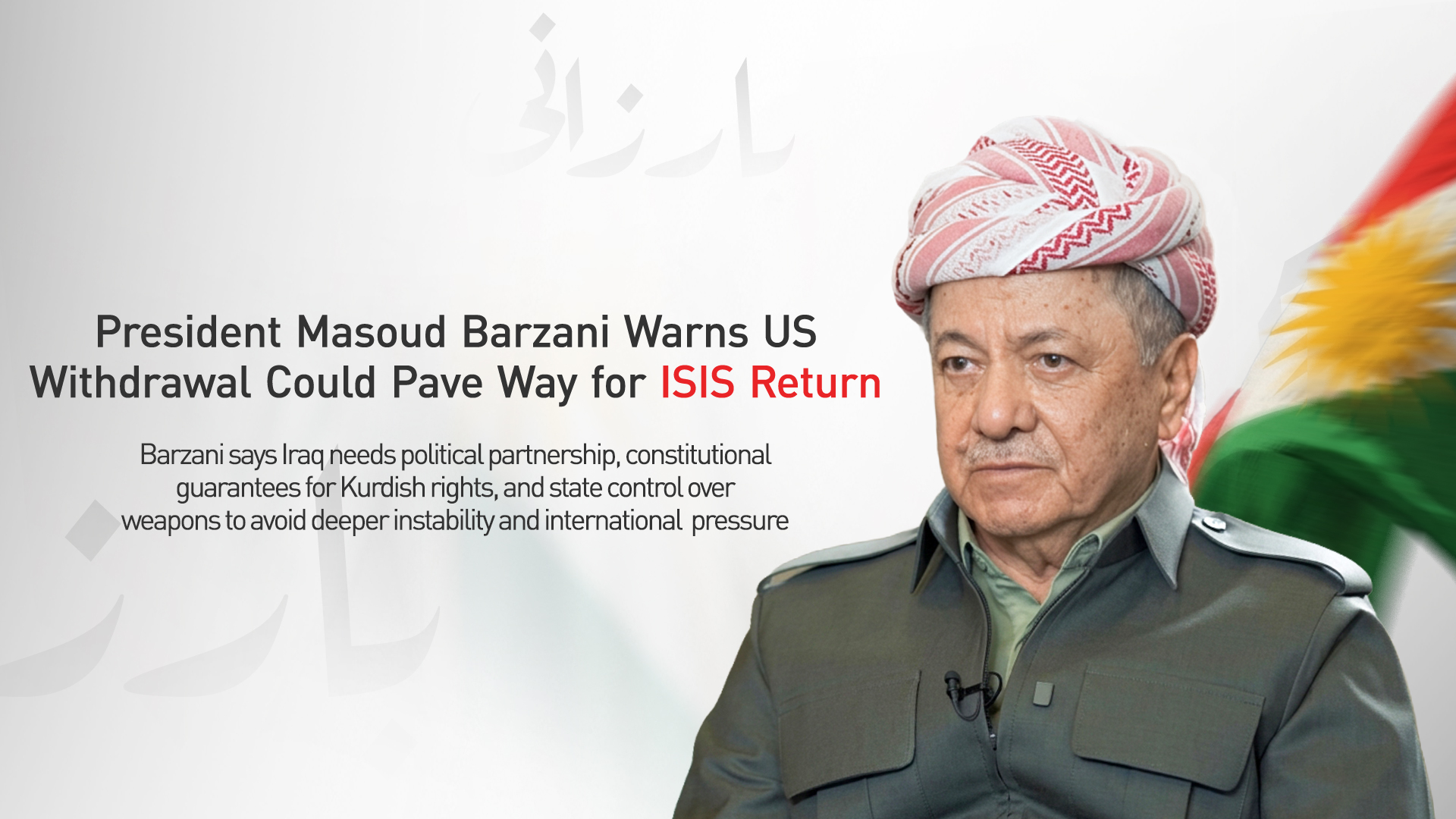
ERBIL () — Kurdistan Democratic Party (KDP) President Masoud Barzani warned that the withdrawal of U.S. forces from Iraq could create conditions similar to those that preceded the rise of ISIS, saying he remains concerned about the possibility of a repeat of the security vacuum that followed the departure of American troops in 2011.
In a televised interview with Al Sharqiya TV, Barzani recalled previous remarks in which he questioned what would prevent ISIS from returning if U.S. forces withdrew from Iraq, saying he continued to hold the same concern.
“I say it and repeat it now,” Barzani said when asked whether he still stood by his earlier warning.
Barzani recalled discussions in Baghdad in 2011 over whether Iraq should conclude a bilateral security agreement with the United States or see American forces leave. He said he had questioned Iraqi defense and interior officials at the time about whether their forces had the capability to fully protect the country.
According to Barzani, the officials acknowledged that they did not have sufficient capabilities, adding that U.S. forces subsequently left Iraq and ISIS emerged several years later.
“I am afraid of the same scenario,” Barzani said, while acknowledging that the current situation differs from that of 2011.
He noted that after ISIS seized large parts of Iraq in 2014, the Iraqi government requested assistance from the United States, European countries and NATO to help combat the militant group.
Barzani’s comments come as the U.S.-led coalition’s military mission in Iraq approaches its scheduled conclusion on Sept. 30. The withdrawal is taking place alongside an Iraqi government push to bring weapons held by armed groups under state control.
Recent discussions in Baghdad have focused on arrangements for regulating and managing faction weapons and preventing attacks on U.S. interests and companies in Iraq.
Barzani criticizes political concentration in Baghdad
In the same interview, Barzani said successive Iraqi prime ministers had faced significant political constraints, describing them as having been deprived of full decision-making authority “to some extent.”
Asked who exercised influence over the prime ministers, he pointed to political parties and said the Coordination Framework had become the main force controlling political decision-making.
Barzani argued that Iraq could not be effectively governed by a single component, stressing the importance of partnership, consensus and balance among the country’s political forces.
He also said the absence of major political actors, including the KDP and the Sadrist movement, would leave Iraq with an incomplete and “paralyzed” political system.
KDP participation tied to agreement with Baghdad
Barzani said the KDP had returned to Baghdad and participated in the government after what he described as a political conspiracy against the party.
He said an agreement had been signed before the formation of the government between the Kurdistan Region leadership and the Coordination Framework, with KDP Vice President Nechirvan Barzani and Coordination Framework leader Hadi al-Amiri among those who signed it.
Barzani said the agreement would serve as the basis for the KDP’s participation in the government and must be implemented.
“We will not be false witnesses,” Barzani said, stressing that the issue was not about obtaining ministerial posts or government positions but about rights, partnership and dignity.
He said the agreement contained no provisions outside Iraq’s Constitution and indicated that its details would be announced soon.
Barzani urges peaceful resolution of weapons issue
On the issue of armed groups and weapons outside state control, Barzani said he hoped the matter could be resolved peacefully and warned against the possibility of armed confrontation.
He said bringing weapons under state control would be in Iraq’s interest and argued that armed groups should only use their weapons on orders from the country’s highest military and political authorities.
Barzani also said the issue could have wider consequences for Iraq if it remains unresolved, including possible U.S. sanctions and international isolation.
“I think Iraq will face major problems,” he said, adding that sanctions and other forms of international pressure could be among the consequences.
The Iraqi government has been seeking arrangements to bring weapons held by armed factions under state authority as the U.S.-led coalition’s current military mission is scheduled to end on Sept. 30.
Kurdish officials have repeatedly argued that the issue should be addressed as an Iraqi national matter rather than solely as a condition imposed by Washington.
Barzani calls for a new political page
Barzani said the KDP had opened a new page with political actors, including Sunni parties that had recently been received in the Kurdistan Region, but stressed that political reconciliation should produce tangible results.
He also warned against any escalation leading to armed conflict, saying such a development would serve neither Iraq nor the Kurdistan Region.
“If this issue is resolved, it will be a victory for all of Iraq,” Barzani said, while acknowledging that reaching an agreement on the weapons issue would be difficult because some actors benefit from maintaining the current situation.
His remarks come amid heightened debate in Baghdad over the future of armed factions, the state’s authority over weapons and Iraq’s relations with Washington and Tehran as the U.S.-led coalition’s military mission draws to a close.