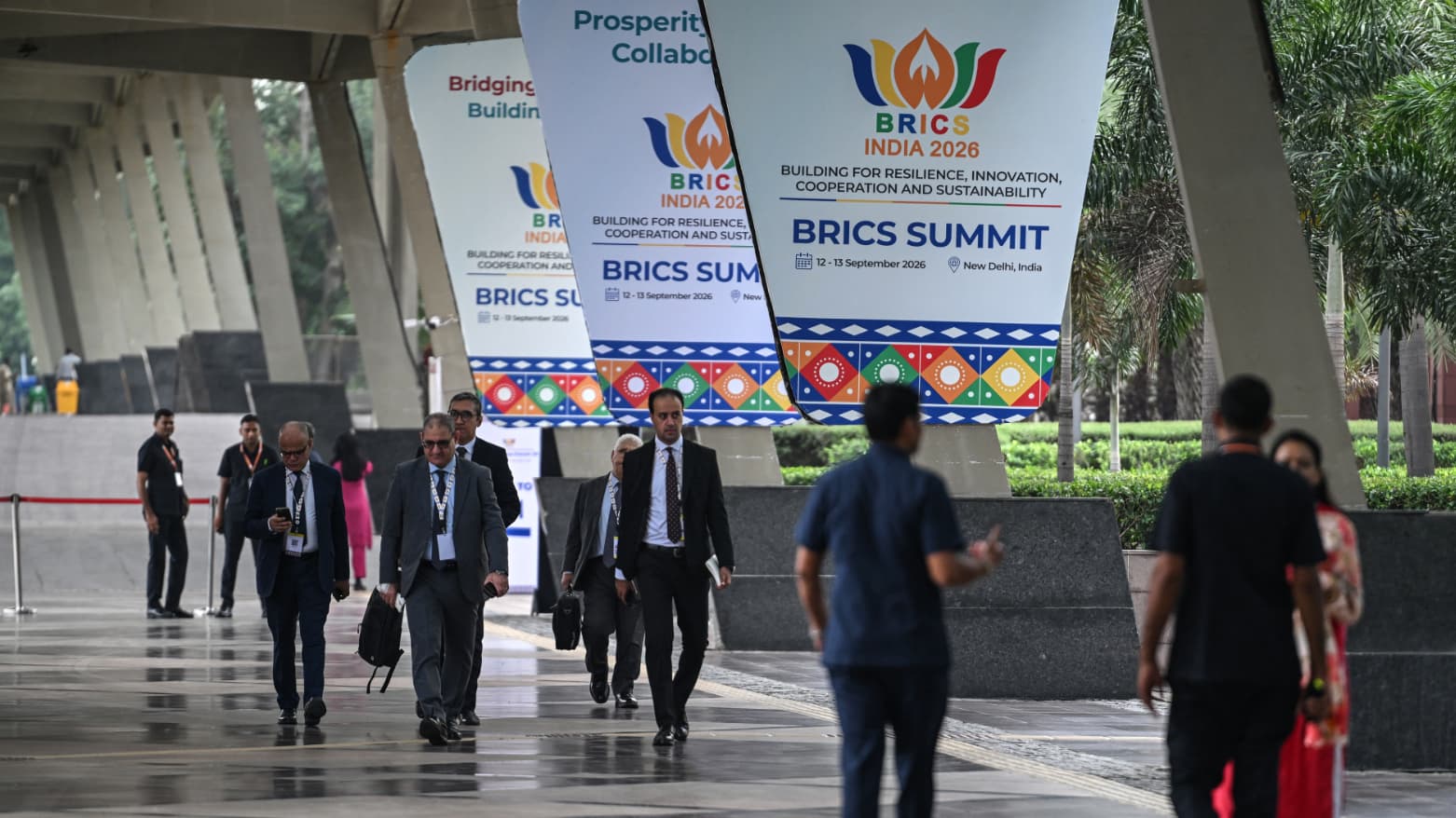
ERBIL () - Leaders of the 11-nation BRICS group called for "maximum restraint"in the Middle East on Saturday, overcoming earlier divisions within the bloc to issue a joint statement warning against further escalation and condemning attacks on civilian infrastructure and safeguarded nuclear facilities.
The statement was released during the BRICS leaders' summit in New Delhi, where Indian Prime Minister Narendra Modi is hosting Chinese President Xi Jinping, Russian President Vladimir Putin, Iranian President Masoud Pezeshkian and leaders and senior representatives from other member states.
"We express deep concern over the continued escalation of tensions in Middle East/West Asia and, recalling our respective national positions, call for exercising maximum restraint, as well as avoiding actions that could further aggravate the situation,"the statement said, according to Agence France-Presse.
The agreement is significant because BRICS foreign ministers were unable to reach consensus on a joint statement when they met in New Delhi in May.
At the time, divisions over the Middle East war, which began with U.S.-Israeli strikes on Iran on Feb. 28, prevented a unified position, with Iran, Saudi Arabia and the United Arab Emirates holding differing views on the conflict.
AFP reported that Saturday's statement followed intensive diplomatic efforts by host India.
BRICS Condemns Attacks on Nuclear Facilities
The leaders also expressed concern over attacks on civilian infrastructure and nuclear sites operating under International Atomic Energy Agency safeguards.
"We express serious concern over deliberate attacks on civilian infrastructure and peaceful nuclear facilities under full safeguards of the International Atomic Energy Agency (IAEA), in violation of international law and relevant resolutions of the IAEA,"the statement said.
It added that nuclear safeguards, safety and security must be maintained even during armed conflict to protect civilians and the environment.
The statement also emphasized the need to keep global trade, supply chains and energy flows functioning in accordance with international law.
"We note the current global context of polarisation and distrust and encourage global action to strengthen international peace and security,"the leaders said.
According to AFP, Xi told the summit that the Middle East war "does not serve the common interests of the international community,"in remarks carried by China's state-run Xinhua news agency.
India Seeks Consensus Across a Divided Bloc
Associated Press correspondents Sheikh Saaliq and Aijaz Hussain reported that the summit is testing BRICS' ability to find common ground amid the wars in Ukraine and the Middle East, along with growing tensions between the United States and China.
Opening the meeting, Modi sought to present BRICS as a platform for emerging and developing economies rather than an alliance directed against Western countries.
"BRICS is not against anyone,"Modi said, according to the AP, while arguing that the grouping had reached a "coming of age"moment in which the Global South should become a greater "rule-shaper"in global governance.
BRICS currently includes Brazil, Russia, India, China, South Africa, Iran, Saudi Arabia, the United Arab Emirates, Egypt, Ethiopia and Indonesia.
The grouping represents roughly half of the world's population and has increasingly pushed for greater influence for developing economies in international institutions.
Russia and China have sought to use BRICS to reduce Western dominance in global economic and political structures, while other members have taken more cautious positions and maintained close relationships with the United States and Europe.
India, in particular, has sought to balance ties with Russia and Iran while continuing to deepen cooperation with Washington and European states.
Trade and Energy Also in Focus
Economic cooperation remains another central theme of the two-day summit.
BRICS leaders are discussing energy, food security, technology, supply chains and reforms of global institutions, while several members are also pushing for increased use of national currencies in trade.
Pezeshkian has supported expanding transactions in BRICS members' own currencies as Iran seeks to reduce exposure to Western financial restrictions.
Modi also proposed the creation of a BRICS network for seafarers, aimed at strengthening safety and welfare for maritime workers as the Middle East conflict disrupts international shipping.
The summit is being attended by UAE President Mohamed bin Zayed Al Nahyan and Egyptian President Abdel Fattah al-Sisi, while Saudi Foreign Minister Prince Faisal bin Farhan was expected to join later Saturday.
For India, securing a joint Middle East statement marks a diplomatic gain after the failure to reach agreement in May.
It does not erase the substantial differences among BRICS members over the war, relations with Washington or the wider regional balance.
But the declaration demonstrates that, at the leaders' level, the bloc was able to settle on a common message: avoid further escalation, protect civilian and nuclear infrastructure, and preserve the trade and energy networks increasingly threatened by the widening conflict.