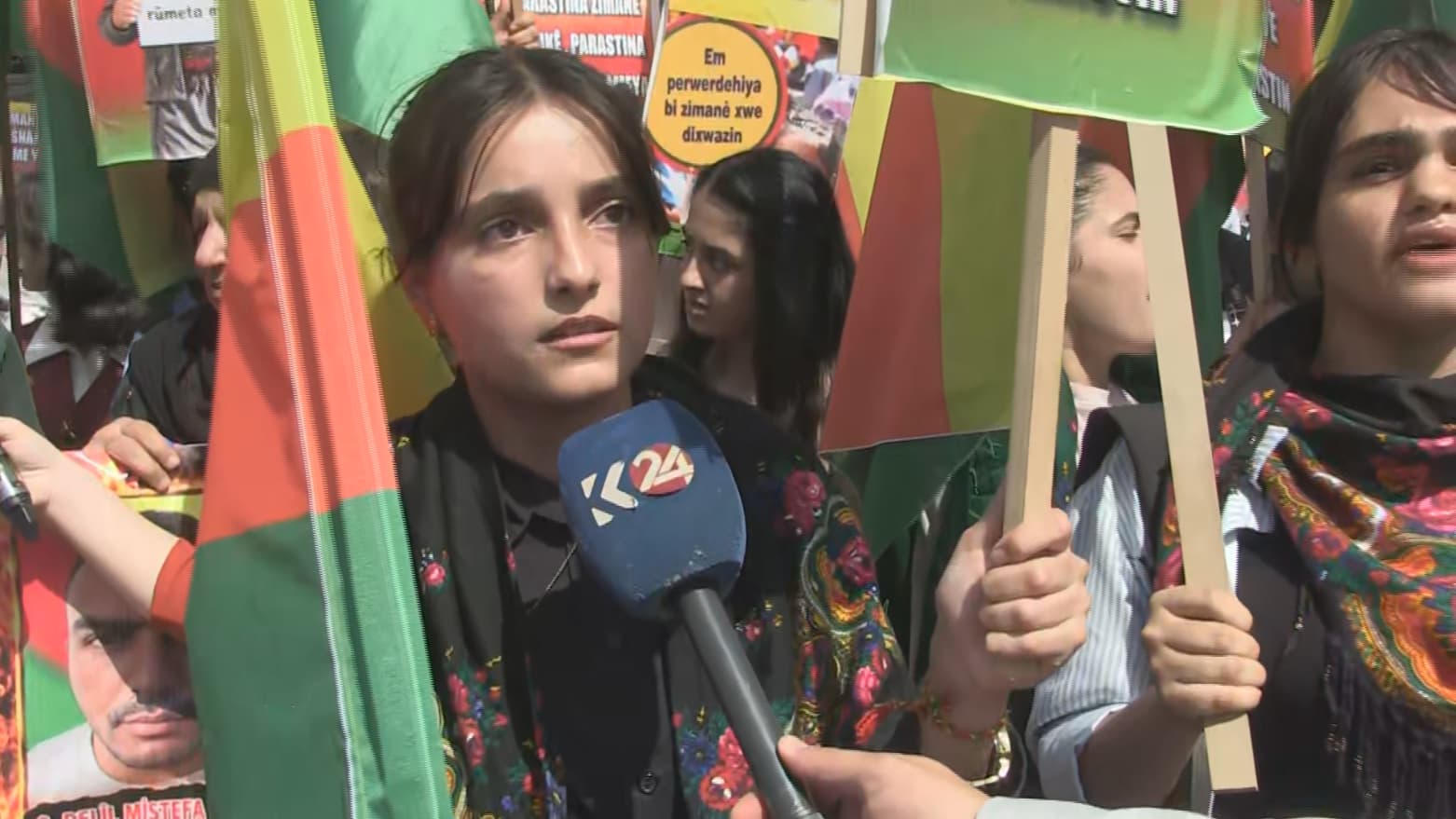
ERBIL () - Hundreds of Kurdish students and family members demonstrated in Qamishlo, Western Kurdistan (northeastern Syria), on Tuesday, demanding comprehensive Kurdish-language education and official recognition of Kurdish, arguing that Damascus's decision to introduce three Kurdish classes a week falls short of guaranteeing mother-tongue schooling.
The Sept. 22 demonstration began at the city's March 12 Martyrs Stadium,'s correspondent in Qamishlo reported. Participants chanted "Our language is our identity"while calling for Kurdish to be used across the education system rather than taught only as an individual subject.
The protest follows a Syrian Education Ministry decision recognizing Kurdish as a "national language"for instruction in schools in areas with significant Kurdish populations.
Under the measures, students are to receive an average of three Kurdish classes each week, along with an additional activity class. Kurdish grades will count toward students' end-of-year results.
But protesters said their demand goes further: they want students to be able to receive their education in Kurdish across subjects, including mathematics and science.
"We have taken to the streets today for education in Kurdish,"one mother told. "Our children have the right to study in their mother tongue."
Another mother said Kurdish should also be recognized in Syria's new constitution and argued that students who have studied in Kurdish for years cannot simply switch their entire education to Arabic.
"As Kurds, we make no distinction between Kurds and Arabs, and we live together peacefully,"she said. "But our children have the right to study in Kurdish."
A student participating in the demonstration made a similar distinction.
"We are not opposed to the Arabic language,"the student said, while demanding Kurdish be granted official status and retained as the language of education for students who have already spent years studying in it.
Damascus Introduces Kurdish Into Curriculum
Syria's Education Ministry announced its Kurdish-language policy in August.
Education Minister Mohammad Abdulrahman Tarkou issued Decision No. 2068/943, amending regulations connected to Decree No. 13 of 2026 and allowing Kurdish to be incorporated into curricula at all educational levels in areas with significant Kurdish populations.
During the first year, students may study social studies, history, geography and philosophy in either Kurdish or Arabic as part of the transition.
The National Center for Curriculum Development was also tasked with preparing Kurdish-language curricula, while education authorities were instructed to recruit qualified Kurdish-speaking teachers.
Candidates are generally required to hold a university degree or teacher-training diploma and demonstrate proficiency in Kurdish, although secondary-school graduates may be employed where staffing needs require it. Teachers must pass written and oral examinations.
The Education Ministry described the measure as intended to protect linguistic and cultural rights while strengthening national unity.
The Qamishlo protesters, however, regard recognition of Kurdish as a subject as insufficient compared with a complete mother-tongue system.
Official-Language Status Remains a Demand
The demonstrations also reflect a broader debate over Kurdish constitutional and cultural rights in Syria.
Mazloum Abdi, an adviser to the Syrian presidency, said during a Sept. 18 meeting in Kobani that discussions were continuing over the language's future status.
Abdi said Kurdish should become both a language of education and an official language, indicating that the issue remains part of wider talks over Kurdish rights.
US Special Envoy Tom Barrack had earlier welcomed the recognition of Kurdish in education while discussing the integration of the Syrian Democratic Forces into Syrian state institutions. He portrayed language recognition as part of a broader political accommodation between Damascus and Kurdish representatives.
Language and identity questions have also surfaced elsewhere.
In Afrin, the Kurdish National Council recently called for the restoration of original Kurdish names to villages, towns and geographic sites that it says were renamed during decades of Arabization policies.
The council requested a specialized government committee to review the issue and restore local names, placing language and cultural identity within the broader discussion over Syria's post-Assad political order.
In Qamishlo, however, Tuesday's message centered squarely on classrooms.
For the students and parents who demonstrated, the disagreement is not over whether Kurdish may be taught, but over how far recognition should go. Damascus has opened Kurdish to formal instruction; protesters are demanding the next step, an education system in which Kurdish can serve as the principal language through which children study their full curriculum.