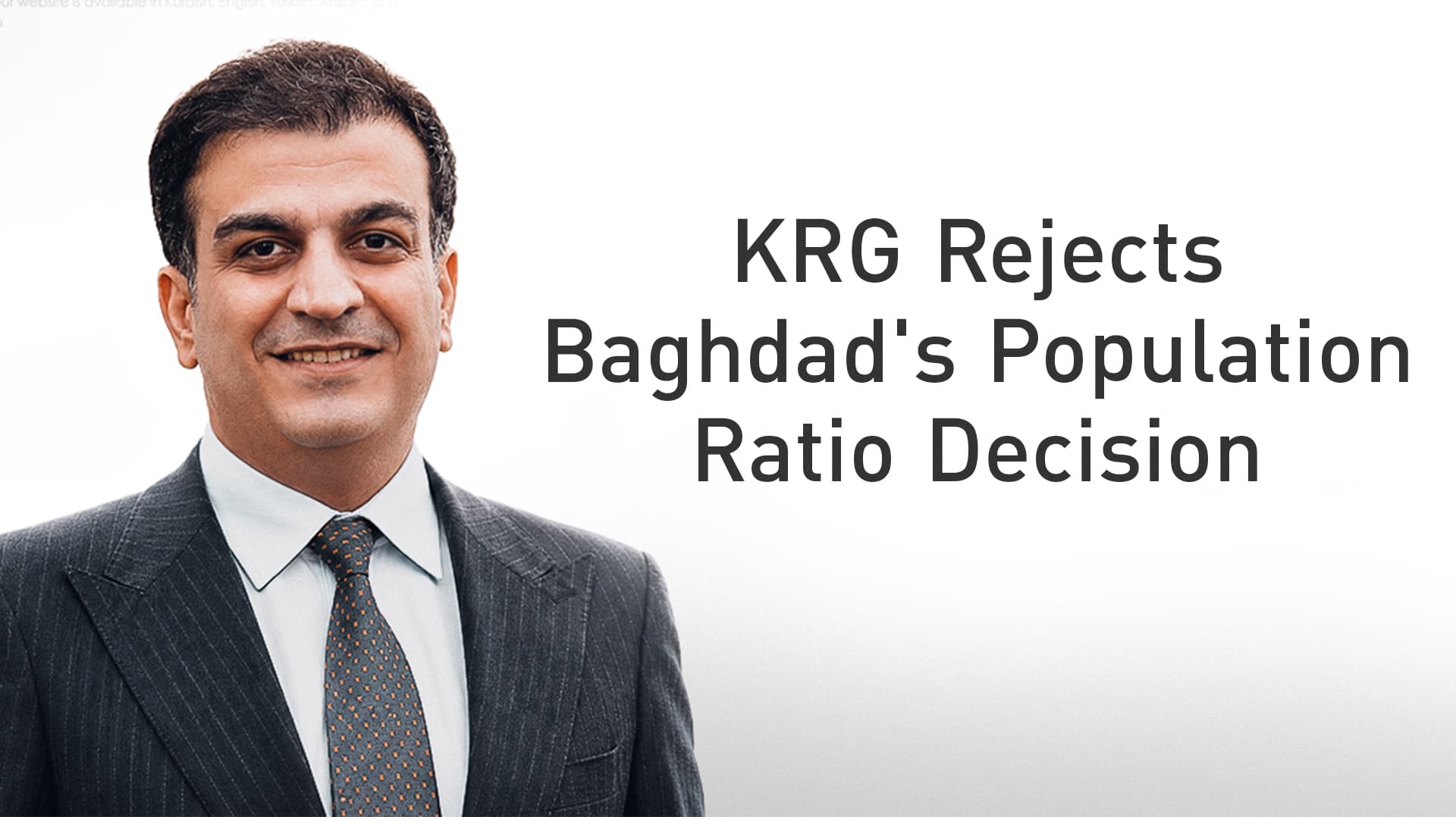
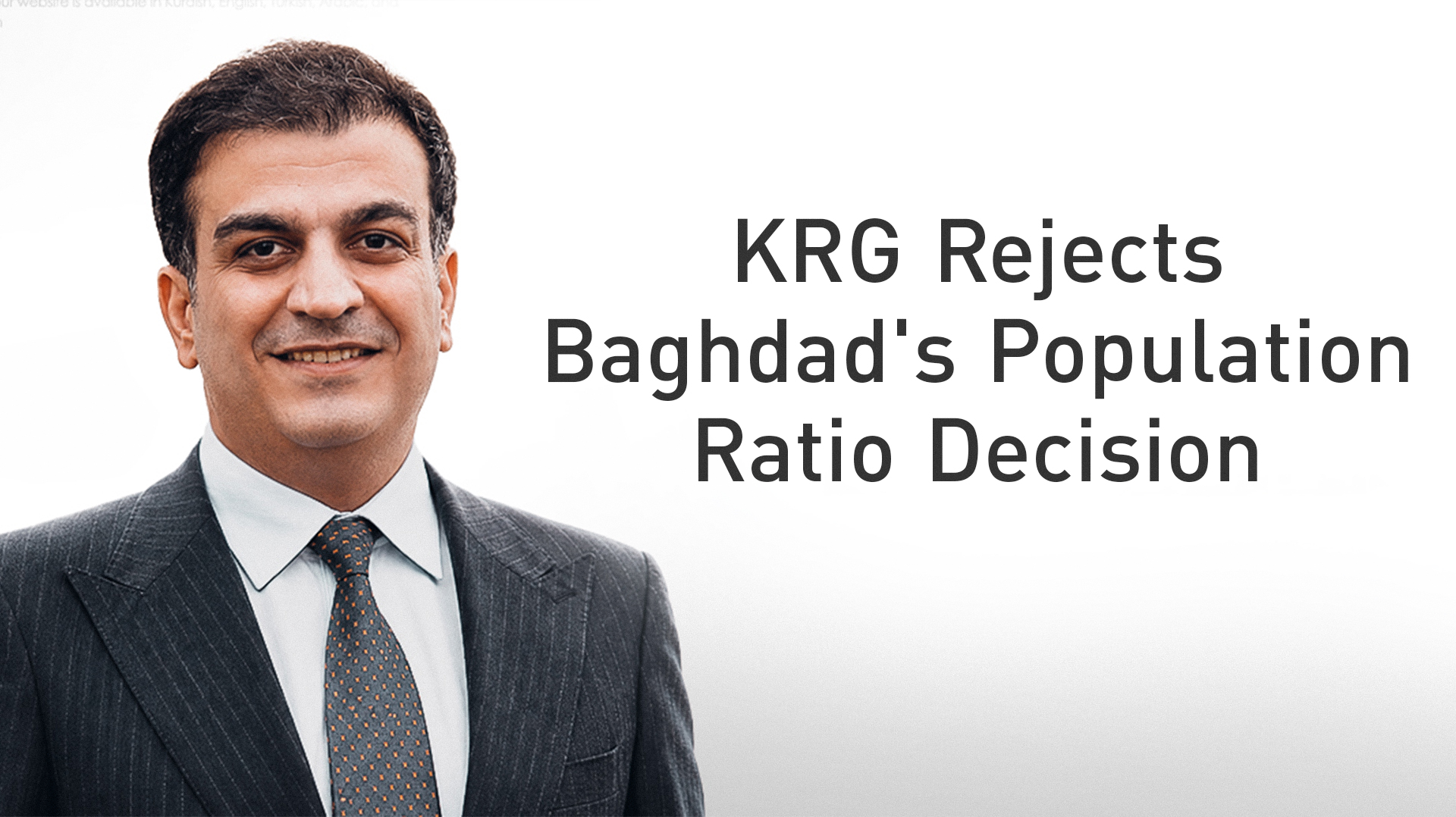
ERBIL () - The Kurdistan Regional Government on Wednesday flatly rejected a federal decision to set the Kurdistan Region's population ratio at 12 percent, calling the move an unjust departure from official census figures and vowing to pursue every legal and political avenue to overturn it.
The rejection came as the KRG Council of Ministers met in Erbil under the chairmanship of Prime Minister Masrour Barzani, with Deputy Prime Minister Qubad Talabani in attendance. Government spokesperson Peshawa Hawramani detailed the session's outcomes at a press conference afterward.
Hawramani said Iraq's Minister of Planning briefed the cabinet on the population figures, noting that while Kurdistan Region's official census places its share of Iraq's population above 14 percent, the federal government has instead moved to fix the ratio at 12 percent.
"This is a very clear and blatant injustice against the people of the Kurdistan Region,"Hawramani said, adding that the prime minister, deputy prime minister and cabinet ministers all addressed the issue at length during the meeting.
He said the KRG "completely rejects this decision"and will pursue every available channel — from direct contact with Iraqi Prime Minister Ali al-Zaidi's office to legal recourse — to reverse it, while calling on all Kurdish factions in the Iraqi Council of Representatives to take a unified stand.
"This is not a political matter, and it is not tied to any single party or faction,"Hawramani said. "This is an injustice being committed against the people of the Kurdistan Region, and it will undoubtedly have very serious negative consequences for the region on every level."
He added that the 12.68 percent figure cited by federal authorities contradicts the findings of the census that the federal government itself conducted and supervised, and that the figure excludes Kurdish areas outside the Region's administrative boundaries. "As the Kurdistan Regional Government, we completely reject this,"he said.
The Council of Ministers also approved a decision covering staff at the Ministry of Education and the Ministry of Higher Education who were hired using internal revenue funds and who have since left their positions for various reasons. Under the new decision, those vacated posts may now be filled.
Hawramani said the KRG's negotiating delegation has held a series of meetings in recent weeks with the Kurdistan Region's political parties, centering on two core demands ahead of Iraq's 2027 budget law.
The first, he said, is that Kurdistan Region civil servant salaries be guaranteed within the 2027 budget bill alongside those of federal Iraqi employees, with no alterations to how KRG staff are paid. The second is that constitutionally guaranteed financial entitlements owed to the people of the Kurdistan Region — and not yet delivered — be paid in full. Hawramani reiterated the call for all Kurdish factions to take a single, unified position on both issues to prevent past shortfalls from recurring.
He added that the KRG has fully met the obligations set out by Iraq's Federal Court, particularly regarding salary payments.
On the "My Account"(Hejmari Min) initiative, Hawramani said Prime Minister Barzani announced a day earlier that the number of Kurdistan Region salaried employees receiving pay through bank transfers has now surpassed one million, with that same number of people now drawing their salaries through ATM machines.
Turning to fuel supplies, Hawramani said the gasoline shortage affecting the Kurdistan Region "is not a problem created by the Kurdistan Regional Government,"noting that the Council of Ministers also discussed the issue on Wednesday. He said the Minister of Natural Resources has formally requested additional supply from the federal government, and that a KRG delegation has traveled to Baghdad for negotiations on the matter.
"We need that additional 50,000 [barrels] added to our share, and Baghdad itself understands that 50,000 is not enough for us,"Hawramani said. "Either they deal with the Kurdistan Region the way they deal with Iraq's other regions, or a solution needs to be found for us as well."He said the 50,000-barrel request was raised again as recently as the previous day, with the KRG's minister in direct contact with federal counterparts, and that talks toward a resolution are continuing.
Hawramani said the KRG has kept the crisis from deepening by distributing gasoline domestically at 750 dinars per liter. "It's good-quality fuel, and people are satisfied with it,"he said, while acknowledging that free-market prices may not match what the government is requesting and that officials are working to bring costs down.
Baghdad's rejection of the Region's census-based population share now stands as the central point of friction between Erbil and the federal government, with Kurdish officials signaling the fight is far from over.