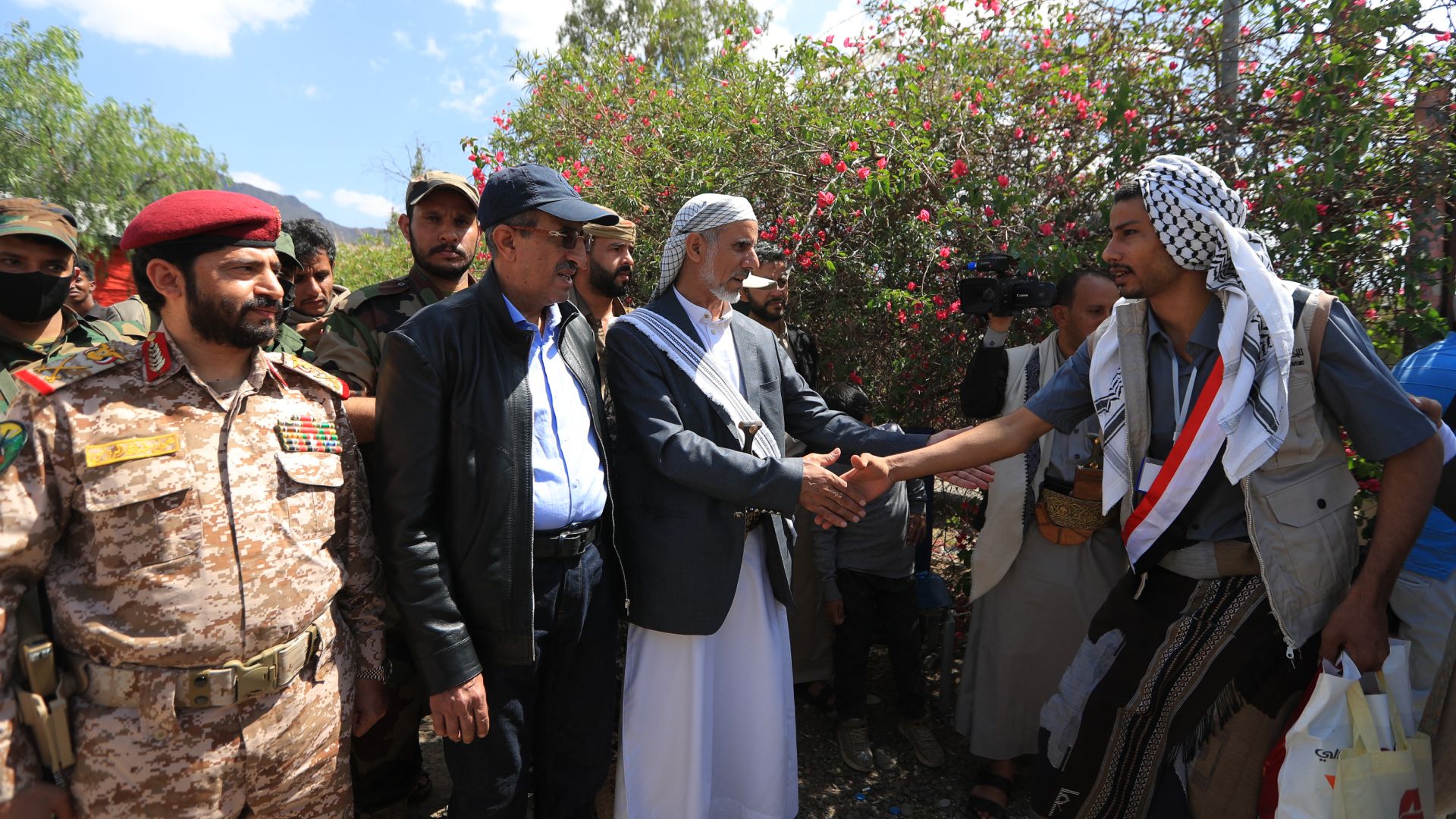
ERBIL () — Yemen’s Houthis said Saturday they had freed more than 200 of their members who had been detained by Saudi-backed pro-government forces in areas seized by the group during its rapid offensive along the Red Sea coast.
Houthi official Abdelkader al-Murtada said 210 prisoners of war had been released from detention facilities on Yemen’s western coast, some of whom had spent years in custody.
“We have welcomed 210 of our prisoners, freed from Saudi enemy prisons on the west coast,” Murtada said at a conference in the Houthi-controlled capital, Sanaa.
The freed detainees were transported to Sanaa on large buses, where they were welcomed by supporters. Some celebrated their release by chanting “Death to America, death to Israel.”
Mohammed Bajash, who said he had spent five years in detention, described his release as a return to normal life.
“I have rediscovered the taste of life. For five years I was in prison, under the yoke of aggression. For five years, I suffered every day,” Bajash told AFP.
Another freed detainee, Mohammed Fawzi, said he had spent three months in detention and described his release as “a moment of indescribable joy.”
The release came amid a sharp escalation in Yemen’s long-running conflict. The Houthis, who already control much of northern Yemen, including Sanaa and the major port city of Hodeida, launched a major ground offensive last week and made rapid gains along the Red Sea coast.
The group captured the strategic port city of Mocha on Thursday after heavy fighting and on Friday said it had taken control of much of Yemen’s Red Sea coast, strengthening its position near the Bab al-Mandab Strait, one of the world’s most important maritime chokepoints.
The Saudi-backed Yemeni government forces said Saturday they had carried out strikes against Houthi fighters and military equipment near Mocha.
“The armed forces destroyed vehicles and weapons and killed members of the Houthi terrorist militia backed by the Iranian regime” near Mocha’s port, the government news agency Saba reported.
Government forces spokesman Majed Abdullah al-Nazili said forces had also targeted Houthi vehicles and fighters along the Mocha-Dhubab road outside the city.
He said Friday that government forces had begun shelling areas in Mocha and urged civilians to avoid the Taiz-Mocha and Mocha-Dhubab roads.
The capture of Mocha prompted many residents to flee toward Aden, where the internationally recognized Yemeni government is based.
Houthi media said Friday that two Saudi strikes hit Mocha’s airport, while a local official said the city’s seaport was struck by six missiles of unknown origin.
The latest escalation has also raised questions about possible US involvement. Axios reported that Saudi Crown Prince Mohammed bin Salman had twice called US President Donald Trump last week to request American strikes against the Houthis.
Trump, however, told reporters Saturday that the Houthis had contacted Washington and did not want to fight the United States.
“They called us and they don't want to fight with us,” Trump said, adding that “everything's gonna work out fine and dandy” in the region. He did not say whether Washington would take military action.
The United States previously conducted a seven-week bombing campaign against the Houthis beginning in March 2025, citing the group’s repeated attacks on international shipping in support of Hamas during the Gaza war.
The campaign ended under a negotiated ceasefire, although the Houthis continued missile and drone attacks targeting Israel.
More recently, the group resumed attacks on shipping in the Red Sea after declaring a maritime blockade of Saudi Arabia, further increasing pressure on a key global trade route.
The latest ground offensive has come at a time when the wider regional conflict has disrupted major maritime routes. The Houthis’ advance toward the Bab al-Mandab Strait has particular significance for regional shipping and energy flows, as the Strait of Hormuz remains closed amid the ongoing US-Iran war.
The fighting has also triggered a major humanitarian displacement. More than 500 people have been killed in the latest offensive, according to sources on both sides, while around 76,000 people have been displaced, the UN migration agency said Saturday. The displacement figure has quadrupled since the previous week.
The latest prisoner release also highlights the unresolved issue of detainees in Yemen’s conflict. In May, the United Nations announced an agreement between the internationally recognized government and the Houthis to exchange more than 1,600 prisoners, but the planned exchange was never implemented.
A major prisoner exchange was carried out in April 2023, when around 900 detainees were released by both sides. It was the largest such exchange since October 2020, when about 1,000 prisoners were swapped.
Yemen’s civil war began in 2014 after the Houthis seized Sanaa and expanded their control over large parts of the country. A UN-brokered truce in 2022 largely halted major fighting, but the conflict remained unresolved before renewed hostilities erupted in July.
The Houthis’ recent territorial gains along the Red Sea coast now mark one of the most significant escalations in Yemen since the 2022 truce, with the group tightening its control around the strategic Bab al-Mandab corridor while the Saudi-backed government seeks to contain its advance.